
Where do udon come from?
Wheat noodles probably reached Japan through contact with China, although exactly when today’s udon took shape is not clearly documented. What is certain is that they have been an everyday food since the Edo period (1603–1868), and they remain especially popular in western Japan.
The most famous style is Sanuki udon from Kagawa prefecture on the island of Shikoku: square-cut with a notably firm, bouncy bite. At the other end of the scale are Inaniwa udon from Akita in the north – thinner, smooth and stretched by hand.
How are udon made?
The dough is nothing more than wheat flour, water and salt. Traditionally it is kneaded for a long time – once even by foot, wrapped in cloth – so that the gluten develops. It is then rested, rolled out, folded and cut into broad strips. Fresh udon cook in just a few minutes; they are also sold par-boiled, frozen or dried.
Hot, cold or fried: the main ways to serve udon
Kake udon is the basic form: noodles in a hot broth of dashi, soy sauce and mirin, topped with spring onions. Countless variations build on it – kitsune udon with sweet simmered fried tofu, tempura udon with battered vegetables or prawns, niku udon with meat.
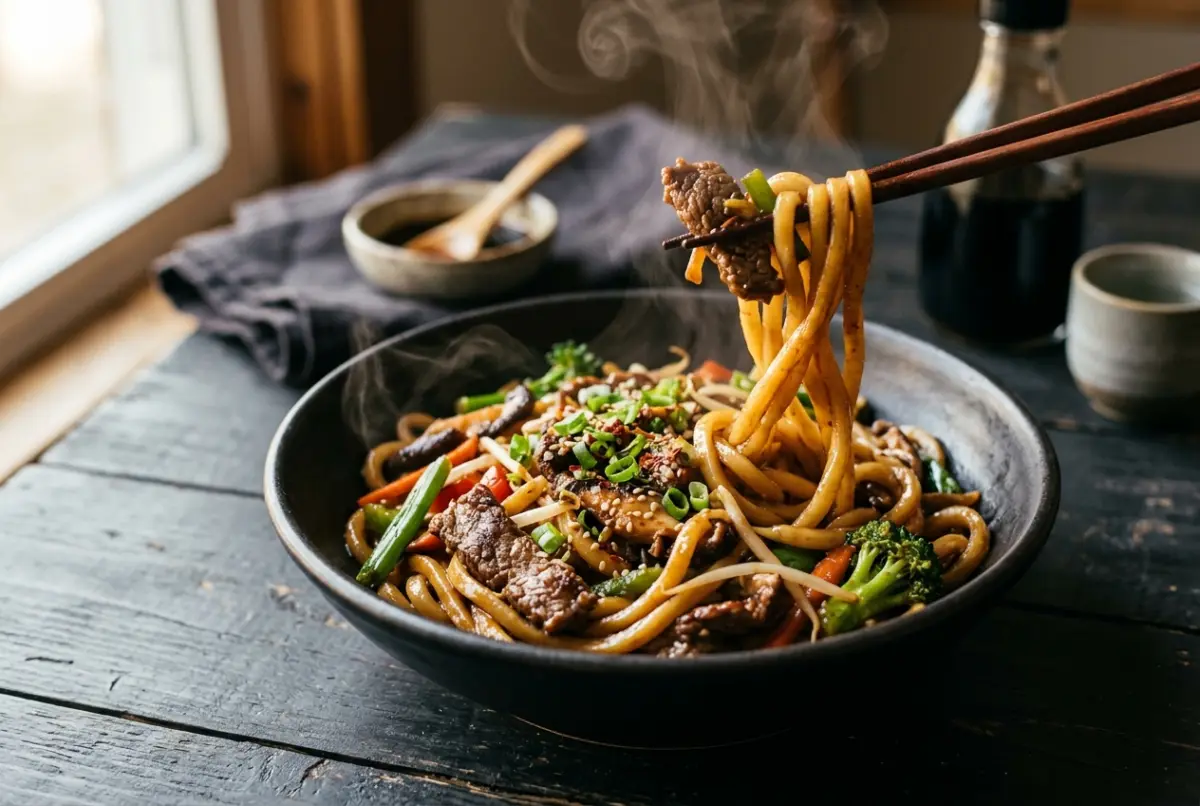
Zaru udon are rinsed in cold water after cooking and served with a dipping sauce – perfect in summer. Yaki udon are stir-fried without broth, with meat or vegetables and a savoury sauce. The dish is said to have been born in post-war Kitakyushu, when soba noodles were in short supply.
Udon vs ramen vs soba
Udon are the thickest of the three and contain no egg or alkaline salts. Ramen noodles are thinner, yellowish and firmer thanks to kansui (alkaline water). Soba are made wholly or partly from buckwheat flour – thin, greyish-brown and slightly nutty. If you want a soft, filling, comforting noodle, udon is the one to order.
Udon at Han Kitchen
At Han Kitchen in Zurich-Oerlikon, udon appear on the Japanese menu as «Yagi Udon with beef and vegetables» for CHF 28.00. The name nods to yaki udon, the stir-fried style. For vegetarians there is Vegi Yagi Udon with vegetables for CHF 23.00.
Start with gyoza (CHF 14.50) or a miso soup (CHF 6.00). Our food is cooked by a former chef of Globus Bellevue in Zurich. Eat in, or call 077 268 20 80 to order ahead and collect – we do not deliver.
Yagi Udon with Beef and Vegetables CHF 28.00 · Vegetable yagi udon (Vegi) CHF 23.00