
Glossary · Restaurant & service

Hangul

Also: Hangeul · Hanguel · 한글

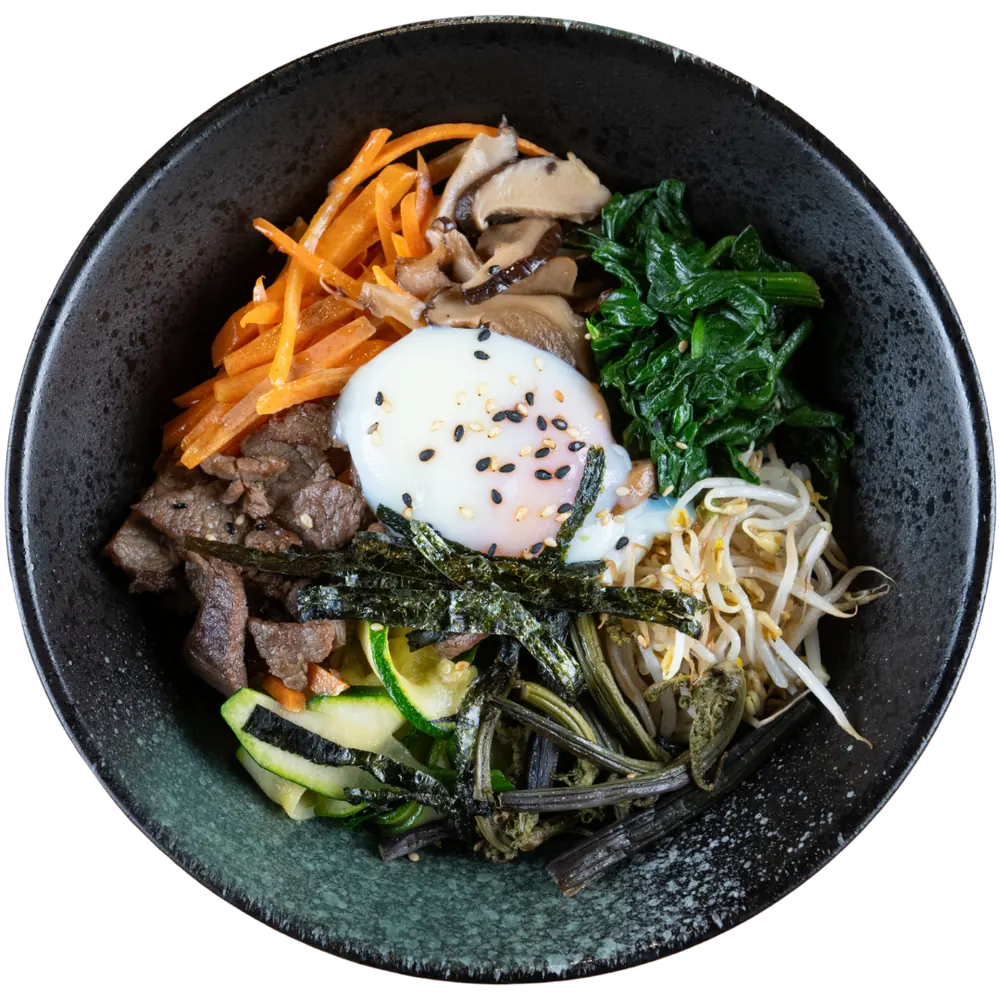
Hangul (한글) is the script used to write Korean. It is a true alphabet with 14 basic consonants and 10 basic vowels, and its letters are combined into syllable blocks. That is why the Korean dishes on the Han Kitchen menu are also written in Hangul – bibimbap, for instance, as 비빔밥.

Bibimbap at Han Kitchen in Zurich-Oerlikon

Where does Hangul come from?

Hangul was created in the 15th century under King Sejong the Great and published in 1446 in a document called «Hunminjeongeum» – roughly «the correct sounds for teaching the people». Before that, Koreans wrote mainly with Chinese characters, which few people had the chance to learn. The new alphabet was meant to let everyone read and write.

South Korea celebrates Hangul Day every year on 9 October. You will also see the name spelt «Hangeul», which is the official South Korean romanisation.

How does the script work?

Each syllable is written as a small block made up of an initial consonant, a vowel and sometimes a final consonant. So the letters are not simply placed side by side as in English, but stacked into a square.

One special case is the circle ㅇ. At the start of a syllable it is silent and simply holds the place; at the end it sounds like «ng». That is why 오징어 (ojingeo, squid) starts with a circle even though you don’t hear it.

Why dish names are spelt differently

Anyone writing Korean in Latin letters has to pick a romanisation. Since 2000 South Korea has used the «Revised Romanisation», but older systems and free spellings are still common. So you will find the same dish as bibimbap or bibimbab, japchae or japche, kimchi jjigae or kimchi jigae.

The Hangul spelling, on the other hand, is unambiguous. If you are looking up a dish or showing it to Korean friends, the Hangul name often helps more than any romanisation.

Hangul on our menu

At Han Kitchen the Korean dishes appear with their Hangul names: 잡채 (japchae), 김치찌개 (kimchi jjigae), 오징어 볶음 (ojingeo bokkeum), 비빔밥 (bibimbap), 김치 제육 볶음 (kimchi jeyuk bokkeum) and 연어 김치 볶음 for our Han Kitchen Special. The vegetarian versions are prefixed with 야채 (yachae, vegetables), as in 야채 비빔밥.

A few words come up again and again and are worth remembering: 볶음 (bokkeum) means «stir-fried», 김치 is kimchi, 제육 (jeyuk) means pork and 연어 (yeoneo) means salmon.

Example

Example: reading 비빔밥 syllable by syllable

비빔밥 has three blocks. 비 = ㅂ (b) + ㅣ (i) → «bi». 빔 = ㅂ (b) + ㅣ (i) + ㅁ (m) → «bim». 밥 = ㅂ (b) + ㅏ (a) + ㅂ (p at the end of a syllable) → «bap». Together: bi-bim-bap. 비비다 means «to mix» and 밥 means «cooked rice», so bibimbap literally means «mixed rice».

Now try 김치: ㄱ (k/g) + ㅣ (i) + ㅁ (m) gives «gim», and ㅊ (ch) + ㅣ (i) gives «chi». Two blocks, and you have the best-known word in Korean cooking.

Bibimbap CHF 32.90 · Japchae CHF 28.90 · Kimchi Jjigae CHF 32.00
At Han Kitchen

Try Hangul with us

Our food is cooked by a former chef of Globus Bellevue in Zurich. Every dish is available to eat in at Baumackerstrasse 46 in Zurich-Oerlikon or to take away.

4.8158 Google reviews
Browse the section:
Take-away

Call & collect

We don’t deliver – simply call us on 077 268 20 80 or drop by during opening hours.

Reservations

Prefer to eat in?

Opening hours

  • Tue – Fri11:30 – 14:00 · 17:00 – 22:00
  • Sat17:00 – 22:00
  • Sun13:00 – 21:00
  • MonClosed
Questions about Hangul

Quick answers

Is Hangul an alphabet or a syllabary?

An alphabet: each letter stands for a sound. The letters are grouped into syllable blocks, though, which is why Hangul can look like a syllabary at first glance.

How many letters does Hangul have?

The modern alphabet has 24 basic letters: 14 consonants and 10 vowels, plus double consonants and combined vowels.

Why is it sometimes bibimbap and sometimes bibimbab?

Because of different romanisations. The final ㅂ sounds like «p» at the end of a syllable, but some people still write «b». In Hangul it is always 비빔밥.

Do I need to read Hangul to order at Han Kitchen?

No. Every dish is also listed with its name in Latin letters and a description.