
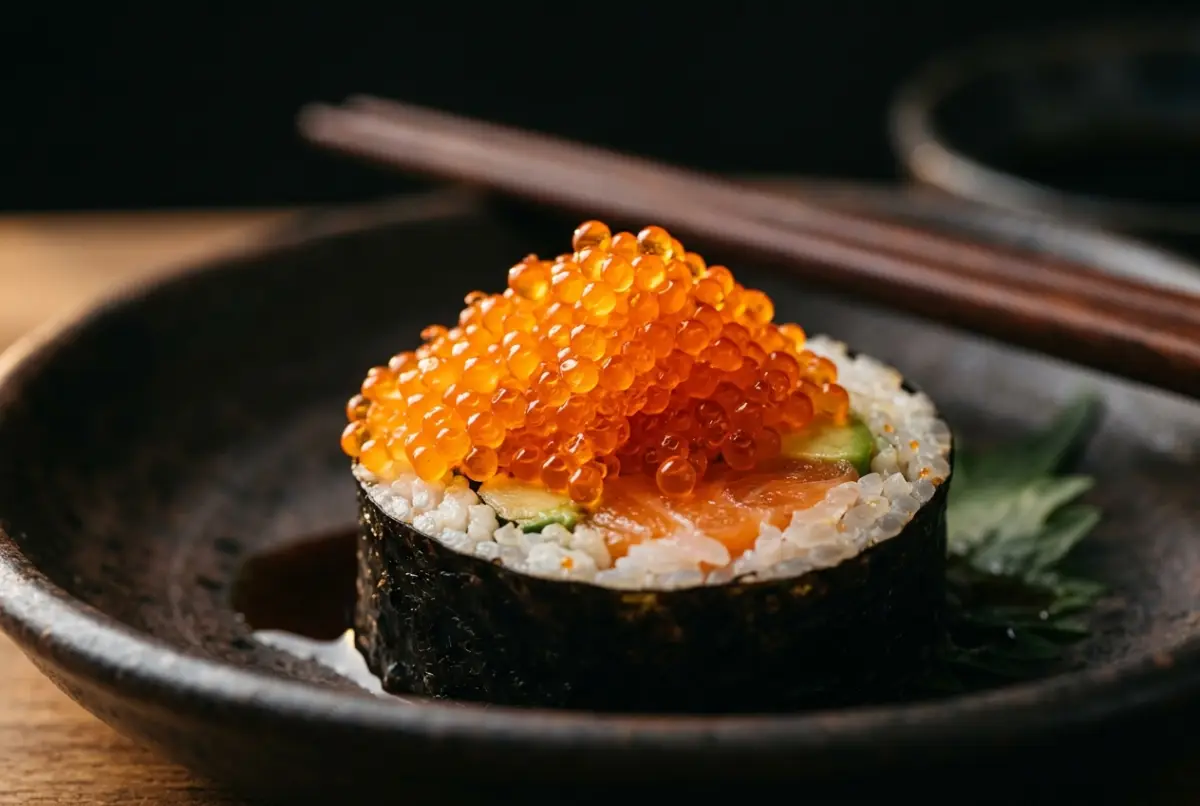
Flavour and texture
What makes tobiko special is the bite: the tiny eggs pop with a gentle crunch as you chew. The flavour is subtle – lightly salty, a little sweet, with a delicate taste of the sea. Tobiko never dominates; it adds texture and seasoning to milder ingredients such as avocado, crab or rice.
For sushi, tobiko is usually seasoned with salt and a little mirin or soy sauce, which brings out its natural sweetness and gives the eggs their sheen.
Why tobiko comes in different colours
Natural tobiko is orange to reddish. It is often coloured or flavoured as well: wasabi turns it green and slightly hot, squid ink turns it black, beetroot or chilli makes it deep red and yuzu gives it a yellow tint. Colourful rolls on sushi platters often owe their look to these tobiko variations.
Tobiko, masago, ikura – the difference
Masago is capelin roe. It is even smaller, less crunchy and cheaper, so it is often used in place of tobiko – at first glance the two look almost identical. Ikura, on the other hand, is salmon roe: much larger, bright orange pearls that burst softly when you bite them. Tobiko sits between the two in size and price.
Look closely and you can recognise tobiko by its slightly larger, even, glossy eggs and its clean pop.
Where tobiko appears in sushi
Tobiko is best known as the outer coating of inside-out rolls, the California roll above all. It is also served as gunkan – a rice base wrapped in a strip of nori – as a garnish on nigiri, or mixed into fillings. As tobiko is raw, pregnant women should be cautious and seek medical advice if in doubt.
Tobiko at Han Kitchen
At Han Kitchen, tobiko features in our California roll, which according to the menu is made with avocado, crayfish and tobiko. The tiny eggs give the mild, creamy roll colour and that characteristic crunchy bite. As with all our rolls, a portion is 4 pieces.
If you are trying tobiko for the first time, the California roll is a good choice, as it contains no other raw fish. Our food is cooked by a former chef of Globus Bellevue in Zurich. Eat in at Baumackerstrasse 46 in Zurich-Oerlikon or take away: call 077 268 20 80 or drop by during opening hours.
California Roll CHF 12.00