
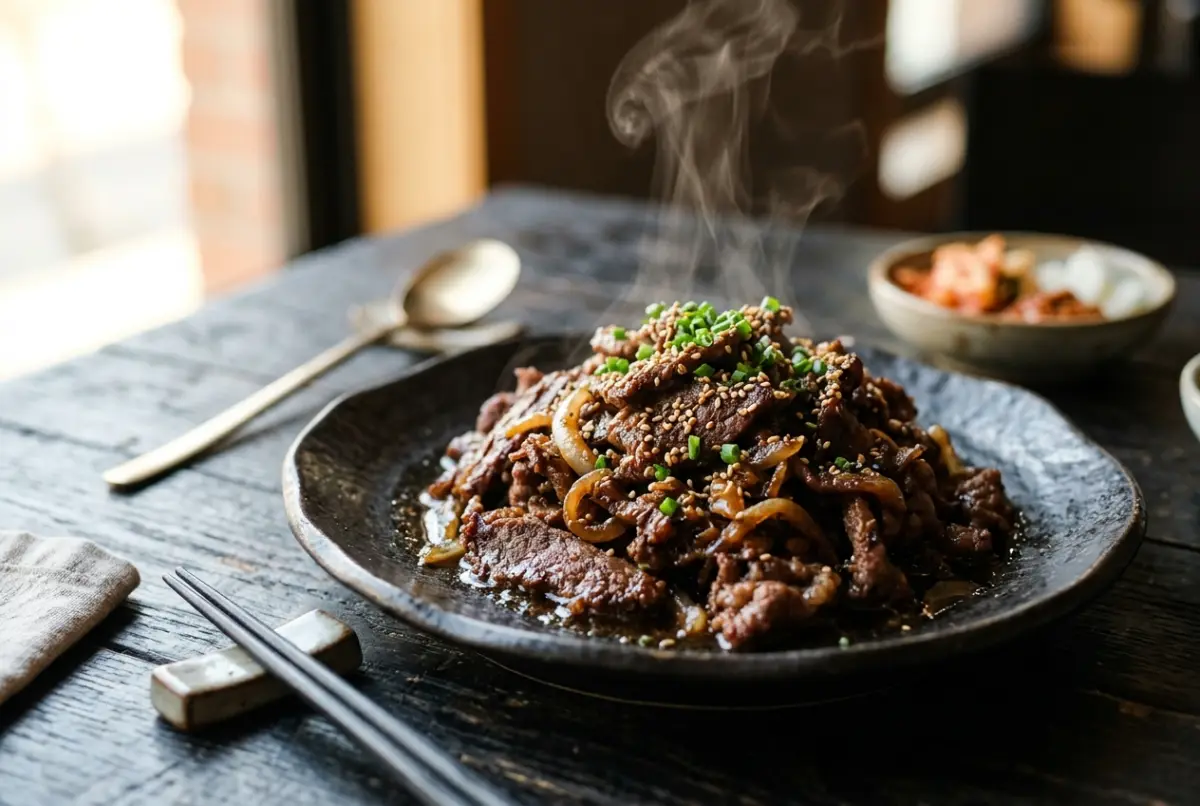
Meaning and history
“Bul” means fire and “gogi” means meat, so bulgogi is meat cooked over or on a fire. Its forerunner is thought to be maekjeok, seasoned meat grilled on skewers in the ancient kingdom of Goguryeo. At the royal court this later evolved into a more refined version made from thin, marinated slices. Today bulgogi is everyday food as well as a favourite for family meals and celebrations.
Unless stated otherwise, bulgogi means beef. Pork versions are called dwaeji bulgogi and are usually spiced with chilli paste; the chicken version is dak bulgogi.
The marinade
A typical marinade combines soy sauce, sugar or honey, garlic, spring onion, sesame oil and black pepper. Grated Asian pear or kiwi is often added: the fruit enzymes tenderise the meat and add natural sweetness. The beef is sliced very thinly, so the marinade soaks in quickly and the meat cooks in moments.
The result is more sweet and savoury than hot, which makes bulgogi a great introduction to Korean food – including for children and anyone who avoids chilli.
Bulgogi vs Korean BBQ
Bulgogi is often equated with Korean BBQ, but they are not the same thing. Korean BBQ (gogi-gui) means grilling meat at the table on a built-in grill or hotplate, with guests cooking it themselves. Many cuts go on the grill, such as samgyeopsal (pork belly) or galbi (ribs).
Bulgogi can be part of a Korean BBQ meal, but it is just as often cooked in the kitchen and served ready on the plate – with vegetables and rice, for example. So ordering bulgogi gets you a specific dish, not necessarily a grill-at-your-table experience.
What goes with bulgogi?
Bulgogi is classically eaten with rice and often wrapped in lettuce leaves (ssam). It also appears as a topping on bibimbap or alongside glass noodles in japchae. Thanks to the marinade, it hardly needs any extra seasoning.
Bulgogi at Han Kitchen
On Han Kitchen’s menu in Zurich-Oerlikon the dish is called So Bulgogi – “so” is Korean for beef. It is marinated, grilled beef with vegetables for CHF 36.90. According to the menu, the beef is from Switzerland.
The dish is served ready from the kitchen; we do not offer table grills or Korean BBQ. Enjoy So Bulgogi in the restaurant or phone ahead for take-away and collect it.
So Bulgogi (beef bulgogi) CHF 36.90