
Origins: from Chinese jiaozi to Japan
Gyoza (餃子) descend from Chinese jiaozi; the Japanese word is simply a reading of the same character. They really took off in Japan after the Second World War, when people returning from north-east China brought the recipe home. Since then gyoza have become an everyday food – in ramen shops, at street stalls, in the freezer aisle and in home kitchens.
Two Japanese cities even compete for the title of «gyoza capital»: Utsunomiya and Hamamatsu. In Hamamatsu the dumplings are traditionally arranged in a circle in the pan and served with boiled bean sprouts in the middle.
How are gyoza made?
The dough is made from wheat flour, water and a pinch of salt and rolled out very thin. Each round wrapper gets a spoonful of filling before it is folded and pleated along the edge. The classic filling is minced pork with cabbage, garlic, ginger and spring onions, but chicken, prawn and vegetable versions are just as common.
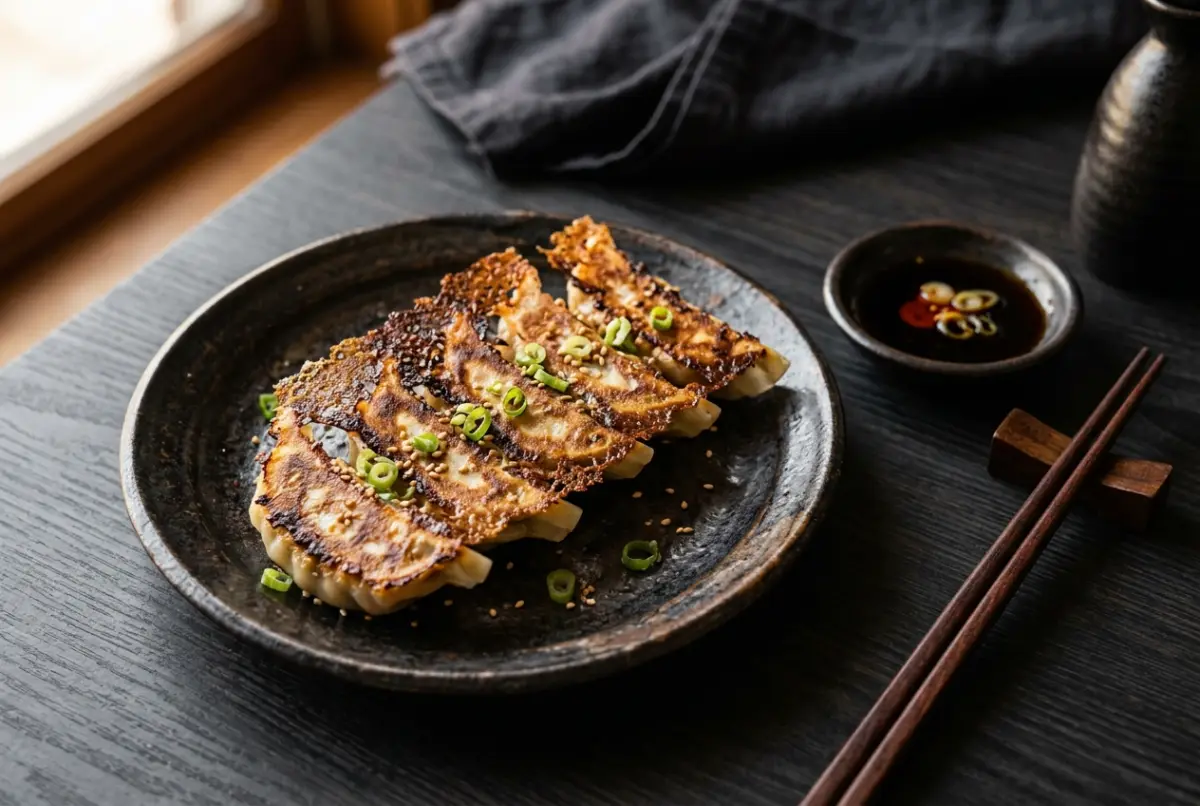
For yaki-gyoza the dumplings are fried in hot oil until the base browns. A splash of water goes into the pan, the lid goes on and they steam through. Once the water has evaporated, the base crisps up again. Some cooks add a little starch to the water so that a thin, lacy «wing» forms between the dumplings – known as hanetsuki-gyoza.
The main styles
Yaki-gyoza: pan-fried and steamed, the best-known style. Sui-gyoza: boiled in water or broth, with a soft, silky skin. Age-gyoza: deep-fried all over, so they are crunchy throughout. Mushi-gyoza: steamed only, especially delicate.
Gyoza, jiaozi and mandu – what’s the difference?
Chinese jiaozi usually have a slightly thicker wrapper and are often boiled. Korean mandu tend to be larger; the filling may include glass noodles, tofu or kimchi, and they are steamed, fried or served in soup. Japanese gyoza are smaller and thin-skinned, mostly pan-fried and often carry a distinct note of garlic and ginger. In English-speaking countries you will also see them sold as «potstickers».
How do you eat gyoza?
In Japan you mix your own dip: soy sauce and rice vinegar in roughly equal parts, with a few drops of chilli oil (rāyu) if you like heat. The acidity cuts through the filling and the chilli adds a kick. Eat them straight away while the base is still crisp – as a starter, alongside ramen or rice, or with a few portions as a meal in their own right.
Gyoza at Han Kitchen
At Han Kitchen in Zurich-Oerlikon gyoza are on the starters list: a portion of 5 pieces costs CHF 14.50. That is enough to share between two before your main course, or as a small plate ahead of a rice bowl such as salmon donburi or bibimbap. If you would like a spread of starters, add edamame (CHF 7.00) and a miso soup (CHF 6.00).
Ask us about the filling in the restaurant or on the phone. Our food is cooked by a former chef of Globus Bellevue in Zurich. Gyoza are available to take away too: call us on 077 268 20 80 or simply drop by Baumackerstrasse 46 during opening hours. We do not deliver.
Gyoza (5 pieces) CHF 14.50 · Edamame (soybeans) CHF 7.00 · Miso soup CHF 6.00