
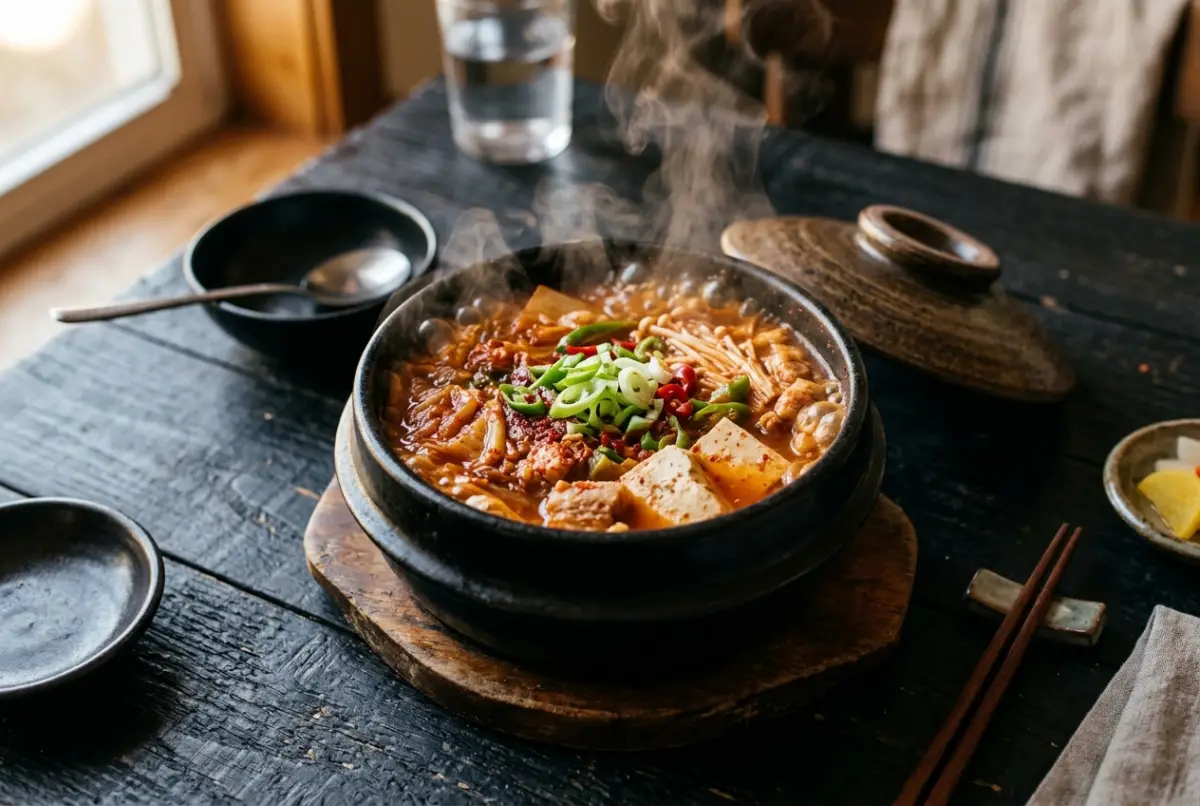
What does kimchi jjigae mean?
In Korean, “jjigae” is a thick, richly seasoned stew – somewhere between a soup and a braise. A jjigae has less liquid than a clear soup (guk) and is traditionally served in the pot it was cooked in. Kimchi jjigae, then, is literally “kimchi stew”.
Spellings vary: on menus you will see kimchi jjigae, kimchi jigae or kimchi chigae. They all mean the same dish (김치찌개).
Why aged kimchi?
Kimchi jjigae deliberately uses older, well-fermented kimchi. It is more sour and softer than fresh kimchi and releases exactly the deep, tangy flavour that defines the stew. In Korean homes, kimchi jjigae is also the classic way to use up kimchi that has become too sour to serve on its own.
As it simmers, the kimchi loses some of its heat and acidity, while the fat from the pork and the mild tofu round out the flavour even further.
Typical ingredients
Alongside the kimchi you will usually find pork (often belly or shoulder), tofu, onion and spring onion. It is seasoned with Korean chilli flakes (gochugaru), sometimes gochujang, garlic and a splash of kimchi juice. There are versions with tinned tuna, with seafood or with no meat at all.
How to eat kimchi jjigae
Kimchi jjigae is eaten hot with rice. Spoon up broth, kimchi and tofu and alternate with mouthfuls of rice – the rice tempers the heat and soaks up the broth. In Korea several people often share one pot; in restaurants it usually comes as an individual portion. On cold days it is the ultimate warming comfort food.
Kimchi jjigae at Han Kitchen
At Han Kitchen in Zurich-Oerlikon the stew is listed as Kimchi Jigae (김치찌개): kimchi stew with pork and tofu for CHF 32.00. It is marked as spicy on the menu, and according to the menu the pork is from Switzerland.
If you prefer your kimchi stir-fried, try the Kimchi Jeyuk Bokkeum or the Han Kitchen Special. Kimchi Jigae is available to eat in or as take-away – just call ahead and collect.
Kimchi Jjigae CHF 32.00